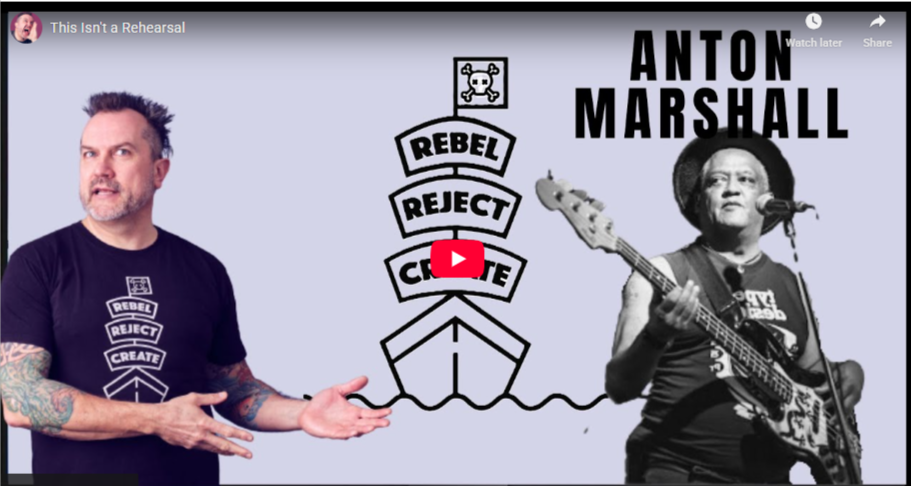
I participated in David Chislett’s incredible series REBEL REJECT CREATE, where he asked me a number of questions related to creativity and alignment..
… and especially what it means to drive towards a life that feels like your own in what feels like a world of endless, mindless conformity.
It’s easy to feel like the “creative life” is something reserved for a lucky few, while the rest of us are stuck managing calendars and fighting burnout. When I sat down with David Chislett for his REBEL REJECT CREATE series, I wanted to dig into why that gap exists—and why it feels so hard to bridge.
If you’ve been feeling like your best ideas are stuck behind a wall of “maybe later,” here is how our conversation might help you break through.
Recognising the “Censorship of Shame”
Do you ever find yourself staring at a blank page or a new project, only to talk yourself out of it before you’ve even begun? You aren’t lazy; you’re likely dealing with what I call the censorship of shame.
Most of us were raised in an education system that treats being “wrong” as a failure rather than a discovery. By the time we’re adults, we don’t fear the work; we fear the criticism. NASA’s Study on children back in sixties even explored this phenomenon in great detail.
In the late 1960s, NASA was keen on hiring innovative minds. To achieve this, they sought to understand the nature of creative genius and commissioned a study led by George Land. The focus was on young children, aged 3 to 5, as they embarked on a journey to decipher creativity. A group of 1,600 kids enrolled in a Head Start program were subjected to a creativity test initially crafted for NASA recruits. The results were startling; 98% of these youngsters were labeled as creative geniuses. However, a follow-up revealed a concerning trend. The genius tag dropped to 30% at age 10 and further down to 12% at age 15. When compared to adults, only a dismal 2% maintained this level of creative genius.
- NASA’s Study on children: How Traditional Schooling Reduces Creative Spark
In the interview, we discuss how recognising this fear is the first step to reclaiming the creative genius we all had as children. It’s about realising that choosing to express yourself is an act of rebellion against a system that wants you to be predictable.
The “No Time” Trap
We all say it: “I’d love to start that project, but I just don’t have the time.” I’ve been there. But in our discussion, I share how I had to stop wishing for more hours and start making harder choices. In the end, it’s about attacking the problem actively, and creating opportunities, not just waiting for them to appear.
If you’re feeling overwhelmed, the solution isn’t more time—it’s smaller steps. It’s about being practical rather than perfect and choosing to “ship” something small today rather than something “perfect” never.
Turning Passion into a Sustainable Reality
The idea of “following your passion” can feel a bit hollow when you have bills to pay. We explored a more grounded approach: aligning your earning with your energy. Instead of a radical leap, think of it as incremental, compounding action. How can you make one small choice today that aligns your daily work with what actually gives you energy? It’s not about an overnight career flip; it’s about a series of daily rebellions that eventually add up to a life that feels like yours.
Using AI Without Losing Yourself
If the rise of AI makes you feel like your human input is becoming obsolete, we tackle that head-on. I don’t believe AI is here to have the ideas for us. Instead, I view it as a tool to help us manifest our ideas. If you’re struggling with the “heavy lifting” of a project, let the tech handle the logistics so you can focus on the soul of the work.
Why Bother?
At the end of the day, I create because I believe in the power of connection. There is no better feeling than knowing someone walked away from a performance or a piece of work feeling a little more “whole” than they did before.
If you’re struggling to find your spark, I hope this interview reminds you that your voice is needed—not because it’s perfect, but because it’s yours.
About the Author



https://shorturl.fm/syR03
https://shorturl.fm/x8WeX
https://shorturl.fm/NIIBk